Showing posts with label learning. Show all posts

Wednesday, September 14, 2011

Powered Up

Most powerful is he who has himself in his own power.
-Seneca

“Think of something that makes you angry,” the instructor says. “Close your eyes and get it in front of you. Do you have it?” The small woman nods, face tight. He places the soft bat in her hands. She grits her teeth and hauls back, knocking a padded bedroll from her partner’s grasp. Whomp! The class jumps. Such force from a tiny person catches us all off guard. The woman and the partner both let out shaky giggles.

“Close your eyes and let that go,” the instructor tells her. “Now, I want you to call up something that fills you with love. Not just something that makes you happy, but something that brings you true joy. Let the experience of it radiate through you. Picture it and feel it. Are you there?” The small woman’s shoulders drop. She smiles and nods gently. “Okay,” he says. “Now.” He hands her the bat.

She winds up again. With a clean, wide arc, she brings the bat down. Crack! The class draws collective breath, her partner lets out a cry, and the bedroll skids across the floor. “Woah!” the woman breathes. She is glowing.

“Man,” says her partner, nursing her hands. “You’re stronger than you look!”

It all seemed little silly at the start. Several of the participants have had to swallow back disdain at the metaphysical, "radiant symmetry" kind of language the instructor uses. However, we suspend disbelief for the sake of the course credit, engaging and observing.

Over and over, twenty-four separate goes, the scenario above plays out. Every participant tries each side of it at least once. And every time, every single time, the force of the latter blow is measurably stronger than that of the former. Both witnesses and participants note the contrast:  The angry hit is sloppy compared to the long, clean swing and satisfying contact of the joyous one. The tightness of the angry hit cannot compare to the way the loving one draws on an unleashed, wide-open momentum. Precision, force, and explosive success are evident in every joyous blow.

So often, we equate power with aggression. Power dominates, and powerful people use force and fear to gain ground. To win. 

Yet, as I sit in this decidedly inside-out kind of class, I watch as aggression falls short. A mightier power overtakes it, outpacing anger and dominance every time. Joy and love win. 

How is this possible?

The purpose of this course for conflict resolvers is twofold. First, we learn to identify the physical manifestations of stress. Second, we develop a physiological aptitude for staying grounded in the midst of highly charged conflict situations. 

Traditionally, social workers, mediators, and other practitioners learn numerous verbal, mental, and even emotional skills to navigate stressful interactions. We think we have a full toolbox at our disposal, but we may not realize the ways our bodies can sabotage our best thinking. Self-protective mechanisms kick in when faced with danger, real or imagined. These reactions are built into our DNA. We feel stress, and our posture contracts. Blood flows away from the brain, our breath quickens, our muscles tense. All of these physical processes prepare us to fight, flee, or submit.

They protect us, certainly, but they do not allow us to provide good attention for the people we aim to serve.

They also don't make us very smart. 

The exercise with the bat and bedroll is just one of many during the two-day class. Each experience illustrates a stunning, measurable link between the body, the brain, and an expansive kind of power. Clearly, calling to mind an experience of joy has an impact on the physiology. The more surprising discovery is that physical choices have a parallel effect on thought. 
 
We breathe deep in our bellies while keeping our stance strong and our eyes open. Doing this, we notice how much more we are able to stay calm and keep our wits about us when someone is hurling insults at us. Paying attention to just these three details – breath, posture, and vision – allows us to keep thinking well, even when someone strides up, snarling into our faces.

By the end of the class, even the swaggering young Palestinian dude and the tough Chicana with the attitude are speaking with excitement about using these skills in practice. Experiencing the contrast repeatedly over two days whittles down our resistance.We may face disdain from peers and scholars, but most of the participants leave the class a little high on the possibilities.

Being able to tap the knowledge available to us even under stress is quite a talent.We are better at what we do when we attend to our physical state. We are able to take in more information about our environment. We are attuned to our surroundings and more perceptive to the opportunities available to us. We can serve. We can lead. We can succeed. Attending to the body, it can be argued, might even make us smarter. 
And with that kind of resource available to us, we are powerful indeed.


Wednesday, June 29, 2011

Don't Know Much 'bout Science Books

The path of least resistance and least trouble is a mental rut already made. It requires troublesome work to undertake the alteration of old beliefs.   – John Dewey

This week, I took a crash course in Blackboard 9.1. For those of you unfamiliar with this product, Blackboard is an online course development and communication tool rumored to have been created by Satan himself. Most of its competitors have perished in the wake of its steady advance towards world domination. Blackboard’s unique format now determines the pedagogical landscape for instructors and students, much the same way Power Point shapes (and cripples) the presentation universe.

Whether evil or handy, this tool is necessary for my job. Every year, our incoming doctoral students take a statistics assessment to determine their quantitative starting points. Design and delivery of the test (though, thankfully, not content), fall to me.

The program coordinator in my department joined me for the training. In the computer lab, we found a small collection of faculty members from our campus. Everyone, it seems, uses Blackboard now, even the professors who have had tenure since the signing of the Magna Carta.

The objectives of the training seemed simple enough. We were expected to learn the basics of getting started with the latest version of Blackboard. The poor instructor from the Department of Instructional Technology had no idea how complicated “simple” becomes when training graduate faculty.  

“Now, we are going to upload a document.”

“All I want to do is post a syllabus!” The professor across from me had a bit of a volume control problem. “Can’t you just show me how to post a syllabus?”

“Yes, sir, that’s what we are doing. Now, go to ‘course content’. . . “

“To what?” He was just a decibel shy of shouting. “To course what?”
  
She walked around to his side of the room. “I’m sorry, I’m not sure what happened here. You’ll need to close your browser and open a new one.”

“Close my what?”

“Click the red X. That will close. . .”

“The what? Click the what?”

“Just click the red X, sir, on the top right corner of your screen, sir, please. . . “

On and on this went, with almost every participant in the room. Ten faculty members needed constant guidance and reassurance. My co-worker and I bit our tongues through each agonizing stretch between tasks. Finally, I realized a course in the basics was not going to get me anywhere close to the level of skill necessary to design on online stats assessment. Instead of seething in poorly disguised frustration, I began exploring.

After discovering the FAQs and a few hidden drop-down menus in the control panel, I was on my way. I created two different tests along with several versions of syllabi and course descriptions. For a few head-scratching moments, I was stumped about making the quizzes live for my cohort of dummy students. I meandered through unfamiliar pages until I unlocked the right door. Meanwhile, my co-worker zipped through her own learning process, pausing every now and then to show me a trick she had picked up.

Twenty minutes before the scheduled end of the session, our dynamic duo was logging out and heading for the door. All around us, faculty members kvetched and interrupted and ran the instructor ragged.

“Why can’t I see it! I can’t see it!”

“You’ll have to turn the editing mode back on.”

“The what? The editing what?”

Learning anything new is a challenge, of course, but that room was filled with some of the brightest minds in their fields. One professor has published ten books. Another is an economist who advises the World Bank and USAID. Since landing this position at George Mason University, I have been in awe of the faculty and their high caliber research. Curiosity and investigative skill should lead the academic mind to explore any unknown subject with aplomb, shouldn’t it? On the contrary, these brilliant thinkers were out of their depth in an online training, needing someone to hold their hands and keep them afloat through what I considered a simple process.

Do we all become pigeonholed? Does our area of expertise so thoroughly define us that we forget our brains are always capable of adapting? Perhaps this is a generational dynamic, but that explanation is too limited. Many professors from across the age spectrum overcome much trickier changes in the academic terrain than a Blackboard upgrade. Outside the ivory tower, age does not correlate consistently with rigidity. My great-uncle decided in his 80s to communicate by email. He wanted to be in touch with far-off friends and family members. With limited mobility, electronic tools were his vehicle. If necessity is the mother of invention, perhaps hunger sires expansion.

It simply never occurred to me that I would not master Blackboard 9.1. I need to learn it to do my work well, and so I will learn it. Maybe the trick is to begin with full faith in the plasticity of the brain. This faith does not preclude toil and even a bit of pulse-popping anxiety about new endeavors. It does, however, set the mind on an inevitable course of expansion. When stagnation is the alternative, learning is the only real option.


Sunday, June 19, 2011

What Happens If?


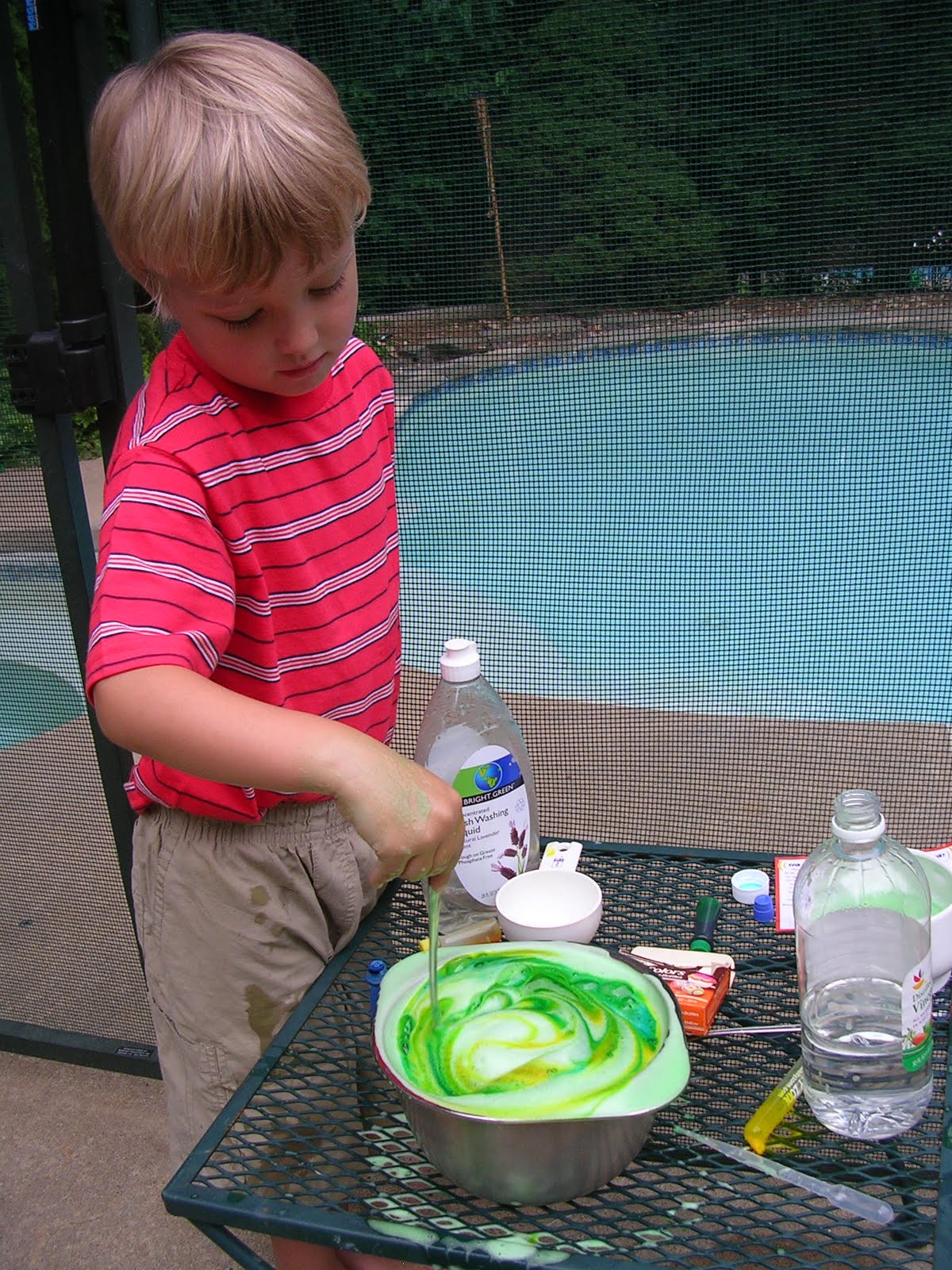
Bug’s latest fascination is “experiments.” These generally take the form of combining corn starch, milk, leaves from the hedges, curry powder, dish soap, and split peas into an unrecognizable glop. He seems to be practicing cooking more than testing a hypothesis, although the line between the culinary and the scientific arts is a fine one.

All this chemistry indicates Bug is primed for the rite of passage required of any young scientist: The Kitchen Volcano. Yesterday, we hopped out back with a collection of household items. “Let’s see what happens,” I said. He was curious, asking me question after question as I urged him to measure, pour, and watch. At one point, he was so uncertain and excited that he stood as far back from the table as he could manage while stirring up the baking soda.

As parents, we sometimes forget our kids don’t know what we know. The meeting between a base and an acid may be dramatic the first few times, but it loses its allure when it turns into a method for refreshing a garbage disposal.

For Bug, this was his first time. My job was to keep my mouth shut and let him explore, refusing to answer his insistent questions. “What will it do, Mommy? Will it explode?”

"What do you think will happen?" I asked. He ignored the question. At a certain point, doing the experiment is far more appealing than thinking about it.


For a twist, Bug had free access to the food coloring. He decided to mix hues, telling me blue with yellow would make red. He was as surprised by the resulting color as he was by the swift rise of his ingredients.  


This was not, Bug made clear to me, a volcano. "We made foamy soap!" Much more exciting, perhaps because it is more real. The boy is just beginning to piece together the origins of the common items in his world. Meat, for example, is a subject of great curiosity. "Which part of the animal are we eating? Is this its skin? How do they get the meat out?" Fun dinnertime conversation. So, it was with great delight and pride that Bug managed to concoct something similar to the stuff he uses to wash his hands.


The fact that it is bright green and a giant mess doesn't hurt.

Friday, April 22, 2011

Day, Earth

In the picture book
our earth is split in half like an egg.
Layers of molten rock press
its yolk into solid metal.
My son studies things about science
every child should know
while at this moment,
his great-granddaughter glances back
with an indulgent smile.
How naive we are, bobbing along
inside the deaf shell
of our incomplete knowledge.
What is real will change
a thousand times,
our truths will become obsolete
when we finally disover
the core is not filled with steel and heat
but seven azure feathers
and a vial of tears
the Sumerian farmer's daughter wept
while she prayed in the dark
for rain.

Friday, April 8, 2011

Flourish

High-hope people believe that the future will be better than the present and that they have the power to make it so. 
- Shane Lopez
The canopy of flowering plums and crabapples bobs under cool April rain. On this Friday when much of the Washington area is battening down the hatches for a government shutdown, a collection of bouyant humans from various corners of the globe parted the morning's curtain of mist and shed both warmth and light on a little corner of Fairfax, Virginia. George Mason University's slick new hotel digs, the Mason Inn, hosted this flagship Leading to Well-Being conference.

You might have a picture in your mind of a bunch of feel-good hedonists trotting out their inner hippies while munching on Marriott canteloupe slices. You might be as surprised as I was to find the list of attendees weighed heavily with research scholars from institutions like Princeton's Woodrow Wilson School, UNC Chapel Hill, and the University of Cambridge. Sure, meditation and yoga sessions were on offer even before the first dry pastry was served, but most of the day focused on the outcomes of scientific studies linking mindfulness to the well-being of individuals, organizations, and even nations.

Historically, much of the psychological field has focused on understanding and eliminating negative emotional experiences. Digging around in people's traumas and patterns was thought to be the way to uproot the bad to make way for the good. The trend now seems to be focusing on constructing positive, healing, and future-oriented approaches to generating well-being. Much more than emphasizing what is not working, most of us need to place greater attention on cultivating practices that move us towards good relationships, purpose, and accomplishment in our lives. As Martin Seligman shared in his keynote, he likes to grow roses. Sure, this involves a certain amount of pulling up weeds and clearing out space. However, "You don't get roses by weeding." To generate meaning and health, what do we plant? What do we work to create?

The research that most captured my attention revolved around the physiological changes occurring when positive emotions are introduced through regular practices such as meditation, appreciation, and caring for others. Measurable neurological changes begin to take place through the simple (though repeated) act of attending. "Attending" can take any number of forms. It might be keeing an eye on the present moment through mindfulness meditation. It also might be an increase in attention to what is going well, to feelings of warmth for a loved one, or perhaps to a hopeful picture of the future. Through any number of these practices, not only do people report a greater sense of well-being, but their brain function also increases.

Researchers are beginning to explore the changes occuring even on a cellular level. The vagus nerve, extending from the base of the cranium to the heart, seems to play a role in regulating cardiac function, as one example. Meditation has been shown to improve the health of this nerve and, consequently, the rhythms of the heart. The effect appears to sustain when the practice is continued, meaning the effect is more than simply a response to novelty. Decreases in illness and increases in longevity are not simply nice side-effects of feeling good. Inflammatory responses seem to lessen with regular practice of attention, and over time, the actual organism - the whole body - becomes more capable of fighting off disease and even thriving.

Putting some of this in the context of daily life, the Losada Ratio is an old-ish tool with new implications. I'm going to be sloppy here, but it more or less explains that the ratio of positivity to negativity in an organization or relationship has an impact on whether or not it will flourish. For each type of relationship, there is a "tipping point" below which dysfunction occurs. For a marriage, the ratio is 5:1. This means for every one dumb-ass thing you say to your spouse, you need to do at least five aweome things to make up for it. Because five is the tipping point, you actually need to be doing, oh, twenty or thirty, for the partnership to thrive. On a day-to-day basis, people in relationships, in workplaces, in classrooms, and in communities need to have a much higher quantity of appreciative, healing, hopeful, postivie experiences for every yucky one in order to acheive well-being.

Shane Lopez, Barbara Fredrickson, and Felicia Huppert were a few of the folks who presented both findings and interventions today. Their publications do a much better job than this little blog at explaining the implications. I am most interested, of course, in how I can apply the ideas as well as the tools to the various quarters of my life. When I am advising doctoral students, how might I employ appreciative techniques to help them through the rigors of the work? Is it possible to encourage both expansiveness of vision and singularity of focus? With my son, how might his daily experience improve if I tell him ten things he is doing well for every one thing that drives me bananas? What forms can mindfulness practice take in the life of a four-year-old, and how can we cultivate them in our rather frantic lives?

Most fascinating is the question of positive emotion in the midst of a divorce. For the past eight months or so, Tee and I have been moving through this separation with amazing control. Neither of us has gone nuclear, and we still speak with decency to one another. However, we have a lifetime of co-parenting ahead, as well as the looming challenge of courts (possibly) and custody arrangements (inevitably). If I am to believe the research, creating a balance of 5 or more:1 even in this relationship is key to making it work. Can you imagine? I somehow have to come up with seven or ten things I appreciate and admire for every one thing I criticize about a man I am divorcing? And I actually have to say them? Out loud? To him?

I am sensing I have the power to set a tone of creativity, hope, collaboration, and caring even in a relationship that is becoming something very different than what either of us wanted or imagined. Ugliness, however, is only one narrative of divorce. It might be possible for us to craft our own story. In the one I am just beginning to envision, Tee and I are the heroes who choose virtue and noble purpose over short-cuts, and our son is the ultimate victor.